

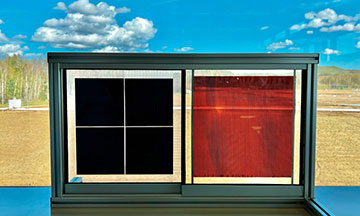
The stability of perovskite–silicon tandem cells (left) and perovskite modules (right) was tested indoors and outdoors. [Image: Courtesy of imec]
Belgium-based startup Noak announced that it has received US$5.5 million in seed funding from the Helios Foundation, Belgium. According to the company, the investment will support the scaling and industrialization of its perovskite–silicon tandem photovoltaic (PV) technology and improve Europe’s solar manufacturing capabilities. The announcement comes just after Noak’s public launch on 30 October, having spun out from Belgian institutions imec and Hasselt University (UHasselt).
Better solar cells
To achieve global climate targets, imec claims that solar PV energy needs to expand from today’s 3 terawatts to 50 terawatts by 2050. Scaling up PV to reach this goal will require enabling the highest possible efficiency and resource productivity. Currently, Europe is limited in both these regards by its industrial and technological capabilities.
According to imec, PV has become “the fastest-growing renewable energy source, driven by rapidly falling technology costs,” but “[Europe] manufactures a negligible fraction of the solar capacity it installs each year,” which has led to structural dependency on imports. In addition, traditional silicon solar cell technology is approaching its practical efficiency limit of 27 to 28%.
To address these challenges, researchers from imec and Hasselt University have spent more than a decade working on perovskite–silicon tandem solar cell technology at the joint Institute for Materials Research at imec and UHasselt and at the EnergyVille campus in Genk, Belgium. The resulting tandem cells, which are the basis for imec and UHasselt spin-off Noak, are built from stacks of a very thin layer of perovskite crystals on top of a conventional silicon cell. Noak claims the technology has the potential to reach efficiencies of 30 to 35%.
A key to the success of this technology is long-term stability in real-world conditions. To this end, the researchers spent five years testing the tandem cells at 10 outdoor tests sites across Asia, Europe and North America to observe how the cells handled varying environmental conditions, like intense sunlight, heavy rain, extreme heat and freezing temperatures.
Toward commercialization
Based on the data that came from this testing, Noak was born with the goal of translating the solar technology for scalable manufacturing. According to imec, the new company will build on its existing dataset to show long-term performance and reliability at scale. “This extensive real-world dataset provides a strong foundation for Noak,” imec said in a statement. “Building on it, the next phase will focus on demonstrating long-term stability and performance at scale, key requirements for bankability and commercial success.”
Noak has also developed a complimentary 3D woven back-contact foil that, when integrated with the cell architecture, moves the electrical connections to the back of the cell. This eliminates front-side metallization and shade loss, so more sunlight reaches the cell and much less metal is needed in production. The company also says that the design supports material recovery and recycling because the cells can be taken apart when they are no longer working. Noak is working toward using only certified recycled metals and using almost no silver in its interconnects.
“Our innovation goes beyond technology,” said Noak CEO Geert Palmers. “We aim to design a value chain through global industrial partnerships without relying on vulnerable critical dominant dependencies. This will enable to navigate between expensive protectionism and volatile globalism.”
