

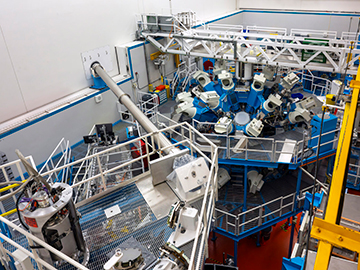
The OMEGA Target Bay at the University of Rochester’s Laboratory for Laser Energetics (LLE). [Image: Jake Deats/LLE]
Laser-fusion startup Xcimer Energy has completed a new round of experiments at the University of Rochester’s Laboratory for Laser Energetics (LLE) to test key physics underlying its approach to fusion power. While the results do not signal that commercial fusion is imminent, they represent another step toward turning laser fusion from a scientific milestone into possible energy technology.
The experiments were supported by the US Department of Energy (DOE) National Nuclear Security Administration and carried out as part of a merit-based program called the National Laser Users’ Facility, designed to give outside industrial and academic researchers access to Rochester’s laser systems.
In inertial fusion, progress requires the understanding of what happens when the laser interacts with carefully engineered targets. Better data can help companies assess the viability of their design approaches before committing to full-scale hardware.
Because LLE’s OMEGA Laser Facility, where the experiments were conducted, cannot replicate Xcimer’s planned reactor geometry, the company used a modified configuration designed to mimic some of the laser-to-target coupling conditions it requires for larger systems. Xcimer’s project focused on externally driven halfraums (half-hohlraums), with particular emphasis on optimizing “mid-Z and baffled halfraums” to test how well different target designs convert laser energy into the X-rays needed to compress fusion fuel.
The experimental shots tested copper, gold and lead halfraums, with the team measuring parameters such as radiation temperature and shock velocity. The goal was to generate and collect data that can improve the computer models used to design future fusion targets. In inertial fusion, progress requires not only the development of powerful lasers but also the understanding and control of what happens when the laser interacts with carefully engineered targets. Better data can strengthen simulations and help companies assess the viability of their design approaches before committing to full-scale hardware.
Xcimer was founded in 2022 and is headquartered in Denver, CO, USA. In 2024 it raised a US$100 million series A funding round and in 2023 received a US$9 million award from the DOE’s Milestone-Based Fusion Development program. The company is also involved in the DOE’s inertial fusion energy hubs under the Inertial Fusion Energy Science and Technology Accelerated Research initiative, which brings together organizations in the public and private sectors as well as government research labs.
