

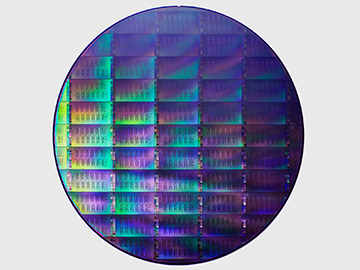
300-mm quantum wafer. [Image: IBM]
On 21 May, the US Department of Commerce announced US$2 billion in federal incentives for nine quantum technology companies under the CHIPS and Science Act. The awards, administered through the CHIPS Research and Development Office, target some of the most consequential unresolved engineering challenges in the race to develop utility-scale, fault-tolerant quantum computers.
The portfolio takes a deliberate multi-modality approach, funding work across superconducting, trapped-ion, photonic, neutral-atom, silicon-spin and topological quantum architectures. The photonics dimension is substantial: Several of the technical objectives named in the award descriptions fall directly within the optics and photonics domain, including photonic loss reduction, integrated photonic packaging, electro-optic material performance, single-photon detection and advanced optical subsystems required for neutral-atom architectures.
Two of the nine awards establish domestic quantum foundry capacity. IBM will receive US$1 billion to build a quantum foundry subsidiary for superconducting wafer fabrication, the largest single award in the portfolio. GlobalFoundries will receive US$375 million to create a foundry capable of supporting multiple quantum modalities. The remaining seven awards target discrete technology bottlenecks: Atom Computing, D-Wave, Diraq, Infleqtion, PsiQuantum, Quantinuum and Rigetti receive awards ranging from approximately US$38 million to US$100 million, addressing challenges across annealing, silicon-spin, neutral-atom, trapped-ion, photonic and superconducting systems.
Three Optica corporate members are among the recipients. While GlobalFoundries and Infleqtion secure funding for their respective foundry and atomic initiatives, PsiQuantum's US$100 million award targets photonic quantum computing specifically, including electro-optic materials, single-photon detectors and ultra-low-loss photonic packaging.
The announcement drew a formal objection from House Science Committee Ranking Member Zoe Lofgren (D-CA), who argued that the awards exceeded statutory authority under the CHIPS and Science Act by funding quantum programs with money appropriated for microelectronics research and by taking equity stakes Congress did not authorize. The administration frames the initiative differently, positioning quantum hardware as an extension of semiconductor manufacturing: The two largest awards establish wafer foundries, with IBM's US$1 billion funding Anderon, a standalone 300-mm quantum foundry in Albany, NY. And the Department casts its minority equity stakes as a taxpayer-protection measure, consistent with recent industrial-policy precedent including the 2025 conversion of Intel CHIPS grants into a government equity stake and the Pentagon's stake in MP Materials.
The US$2 billion commitment represents one of the largest federal investments in quantum computing hardware to date. For the photonics community, the structure of the awards is as significant as their scale. By framing optical performance as a gating factor for quantum hardware rather than a downstream concern, the Commerce Department's initiative positions photonics not as an enabling layer but as a central determinant of progress toward fault-tolerant quantum computing.
