

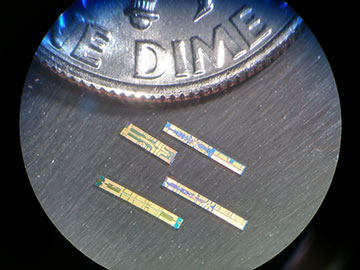
InP laser diodes developed by Freedom Photonics, which was acquired by Luminar in 2022. [Image: Business Wire]
Integrated photonics company Quantum Computing Inc. (QCi), USA, announced that it has signed an agreement to acquire Luminar Semiconductor, Inc. a wholly owned subsidiary of Florida-based Luminar Technologies, Inc., in an all-cash transaction of US$110 million. The announcement comes in the wake of Luminar’s filing for Chapter 11 bankruptcy protection.
According to QCi, the acquisition will bring the company a portfolio of core photonic technologies, patents, and a team of engineers and scientists that will accelerate QCi’s roadmap while continuing to support and grow LSI’s established customer base.
QCi looks toward quantum integration
Established in 2021 as Luminar’s photonics unit, LSI was born of four companies previously acquired by Luminar: the 1550-nm laser producer Freedom Photonics, photodiode specialist Optogration, chip-design firm Black Forest Engineering, and optical components manufacturer EM4. The subsidiary was established to bring development of receiver, laser and processing chip technologies in-house.
LSI manufactures and sells a portfolio of photonic components, including application specific integrated circuits, avalanche photodiode detectors, tunable lasers, PICs, pump lasers, passive micro-optics, and integrated modules, that QCi says are “important building blocks” on its technology roadmap. QCi is focused on thin-film lithium niobate photonic chips for applications in integrated photonics and quantum optics, and the company recently opened a TFLN foundry located within Arizona State University’s Research Park in Tempe, AZ, USA.
“This acquisition represents a meaningful step forward in our strategy to develop and scale practical, integrated quantum solutions,” said Yuping Huang, QCi CEO and Chairman of the Board. “The post-closing revenue opportunity will be two-fold: to serve and expand LSI's current non-quantum customer base; and to utilize LSI's technology and products to drive the commercialization of quantum appliances in our targeted markets.”
Luminar draws to a close
Luminar, which deployed lidar sensors for automotive applications, filed for Chapter 11 bankruptcy protection on 15 December following a tumultuous stretch. Company founder and CEO Austin Russell resigned in May after a code of business conduct and ethics inquiry by the audit committee of the company’s board of directors. In late October, the company laid off 25% of its workforce amid financial difficulties and missed interest payments. Financial results for Luminar’s third quarter ending 30 September, indicate revenue between US$18 and 19 million and debts of US$429 million, with cash reserves of US$74 million.
Finally, in mid-November, automaker Volvo terminated its supply deal with Luminar, depriving Luminar of its key anchor customer. Volvo had previously deployed Luminar’s “Iris” lidar system as a standard feature on its EX90 electric vehicles and had been planning to do the same with its new ES90 models.
“Over the past six months, we have taken meaningful steps to drive operational discipline, streamline our cost structure, and sharpen our strategic direction, but our legacy debt obligations and the pace of industry adoption have challenged our ability to operate the business in a sustainable way,” said Luminar CEO Paul Ricci.
Since Luminar agreed to sell its photonics subsidiary to QCi prior to the filing, LSI will not be a debtor in Luminar’s Chapter 11 cases, and its operations should be unaffected by the bankruptcy filing while Luminar seeks a buyer for the remaining lidar operations. The company also noted in a press release that it had filed a number of customary “First Day Motions” to enable it to continue payment of employee wages and benefits, honor commitments to customers, and satisfy obligations to vendors and partners incurred after the filing date.
