

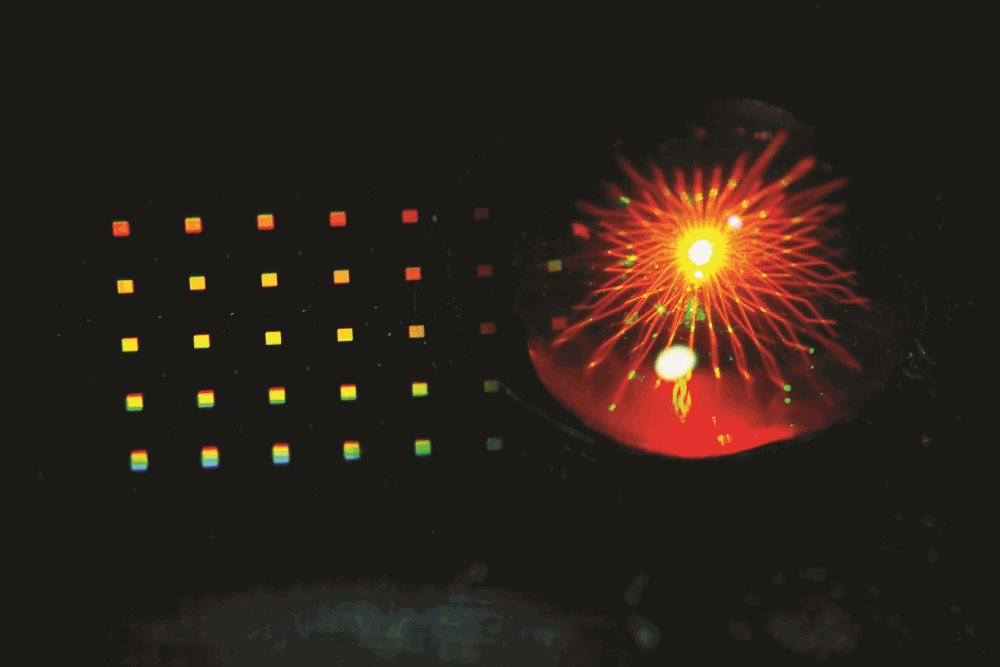
A droplet of fluorescent molecules
A droplet of fluorescent molecules sits atop an array of nano-sized holes. An excitation laser from below is diffracted by the nanohole array, causing a "bloom" of internally reflected fluorescence within the droplet. The fluorescence from this array was used to calibrate the field-dependent aberrations of a super-resolved fluorescence microscope (see article submitted to Optica, 2015). [Winner 2015 After Image photo contest.] —Matthew D. Lew, Washington University in St. Louis
—
29 Nov 2015
—
29 Nov 2015

The Evolution Of Electric Light Bulbs
Imaged with the X-rays of Nikon's XTH225 CT system (left: Edison style incandescent light bulb, center: fluorescent light bulb, right: LED light bulb). In 2014, the invention of efficient blue light-emitting diodes (LEDs) was awarded the Nobel Prize in Physics. Subsequently, the United Nations declared the year of 2015 the International Year of Light and Light-based Technologies. [Third Place 2015 After Image photo contest.] —Herminso Villarraga-Gómez, Nikon Metrology Americas & University of North Carolina at Charlotte U.S.A.
—
29 Nov 2015
—
29 Nov 2015
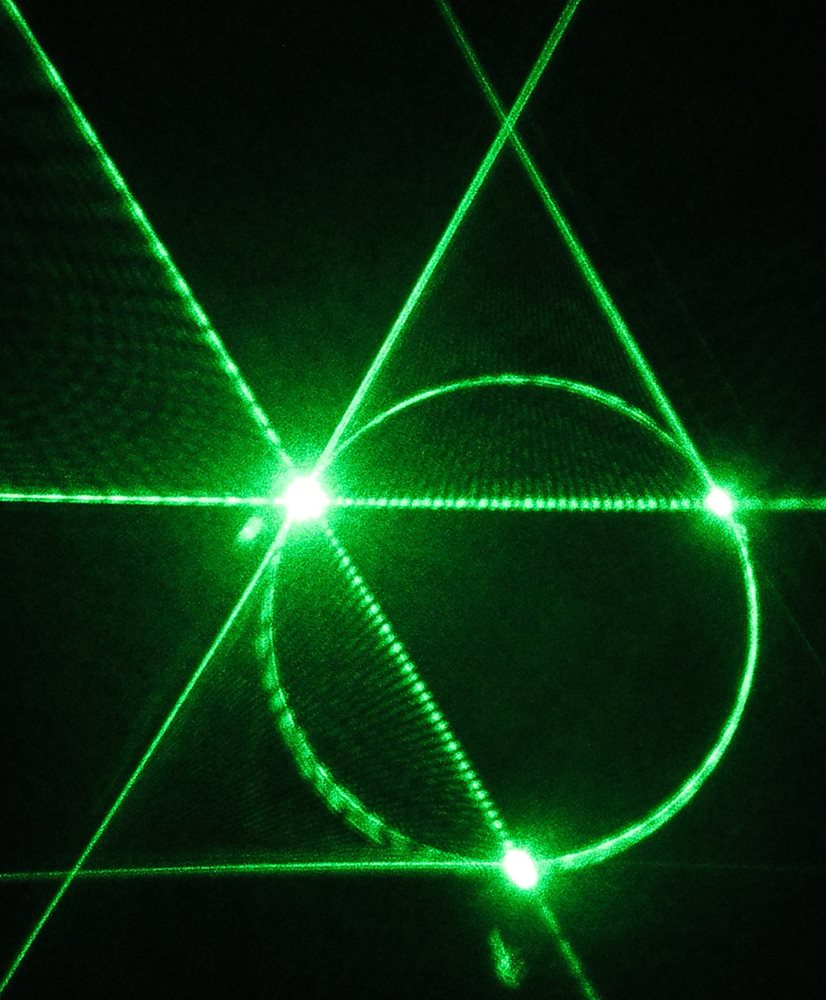
Light scattering in soap bubbles
Parhelic-like circle obtained with light scattering in soap bubbles. We have done a connection of this light pattern with the atmospheric optical phenomena known as parhelic circle, sun pillars and sun dogs. These phenomena are so interesting that, when they were observed in the sky of Rome in 1629, they led René Descartes stop thinking about Philosophy and turn his intellectual enthusiasm on the subject of Optics.[Honorable Mention 2015 After Image photo contest.]—Alberto Tufaile, University of São Paulo
—
29 Nov 2015
—
29 Nov 2015
Laser light diffracting in a cone
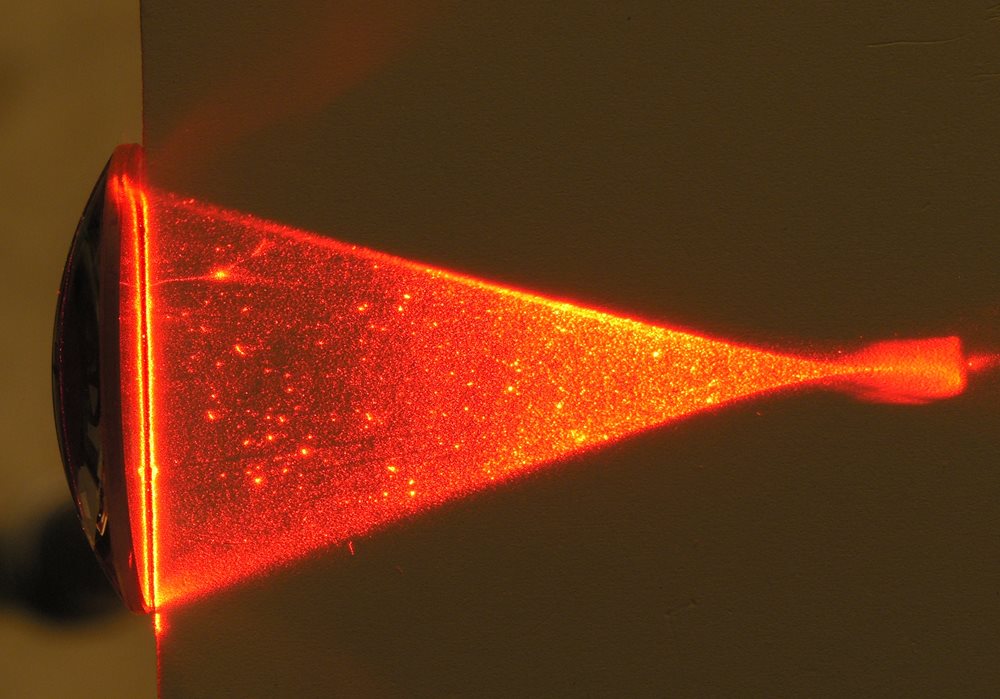
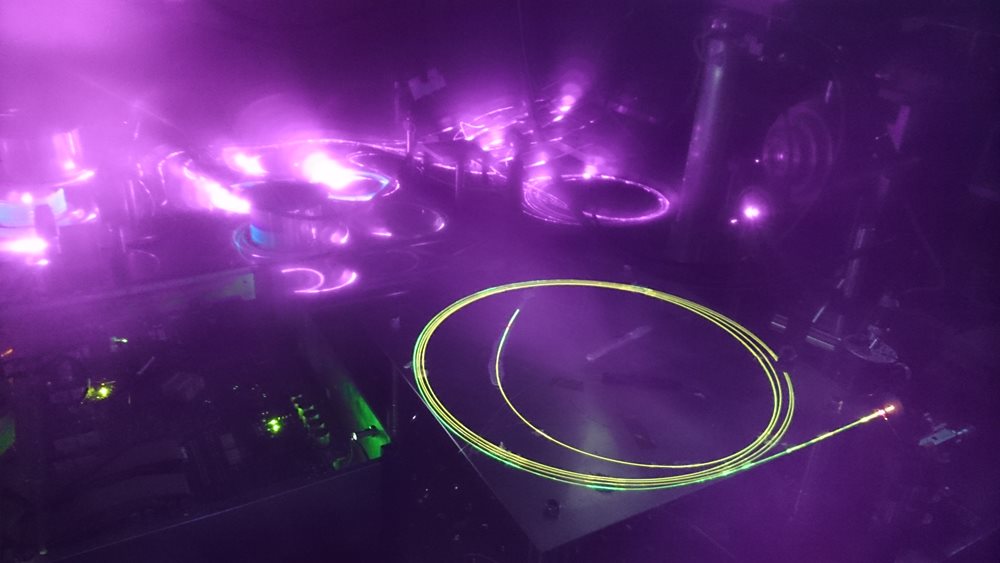
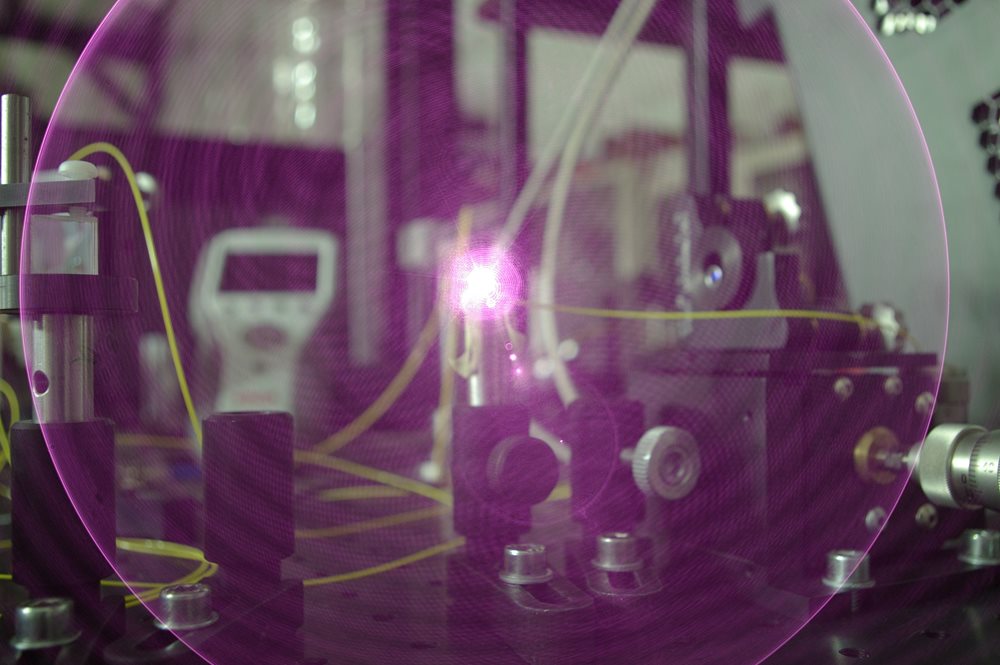
A direct image of the bare fiber tip, output port of the ytterbium femtosecond fiber laser of my construction. The laser light diffracting in a cone from a fiber tip is at 1,030 nm wavelength, and it is directly shot by the DSLR camera. —Radosław Chrapkiewicz, Optics Division, Faculty of Physics, University of Warsaw, Poland
—
29 Nov 2015
—
29 Nov 2015
3-dimensional nested ring of light
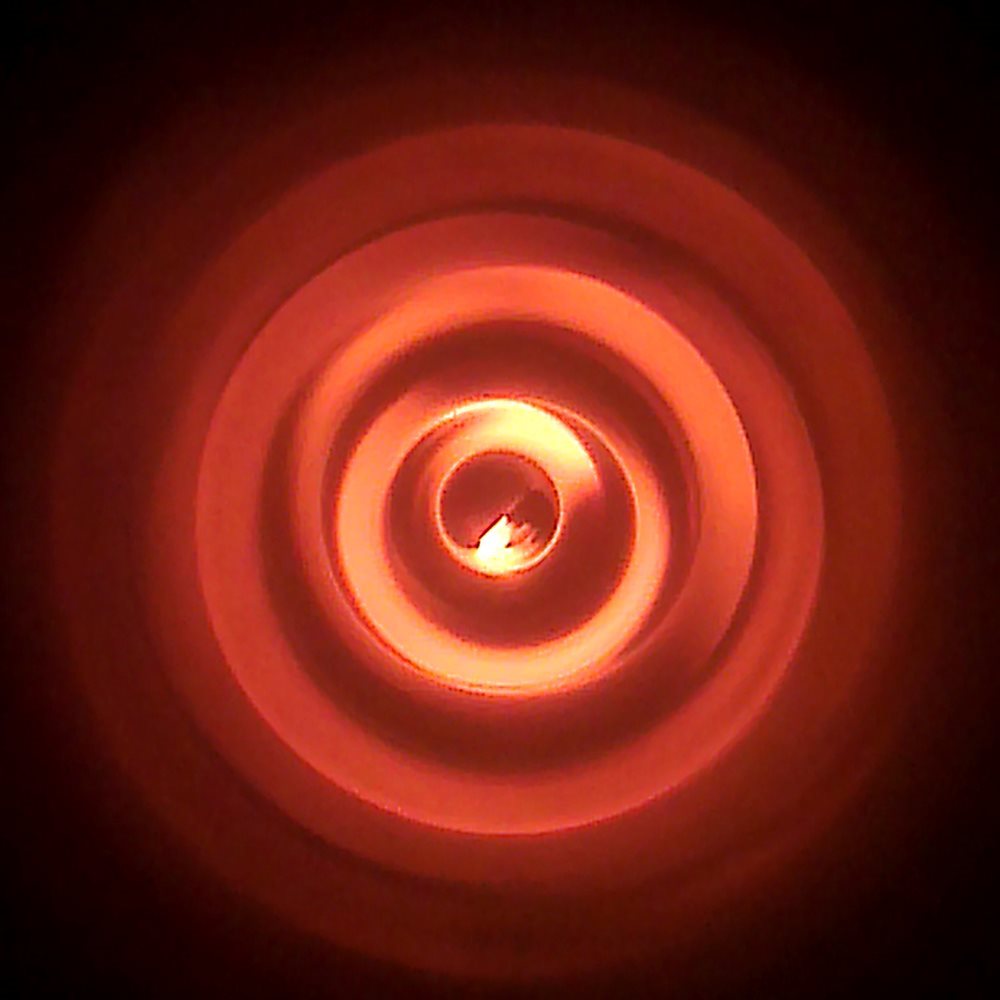
This beautiful 3-dimensional nested ring of light was produced experimentally by placing a large glass capillary in front of a glowing heating element with an angular offset to excite skew rays that follow a helical path around the capillary axis.—George Y. Chen, University of South Australia
—
29 Nov 2015
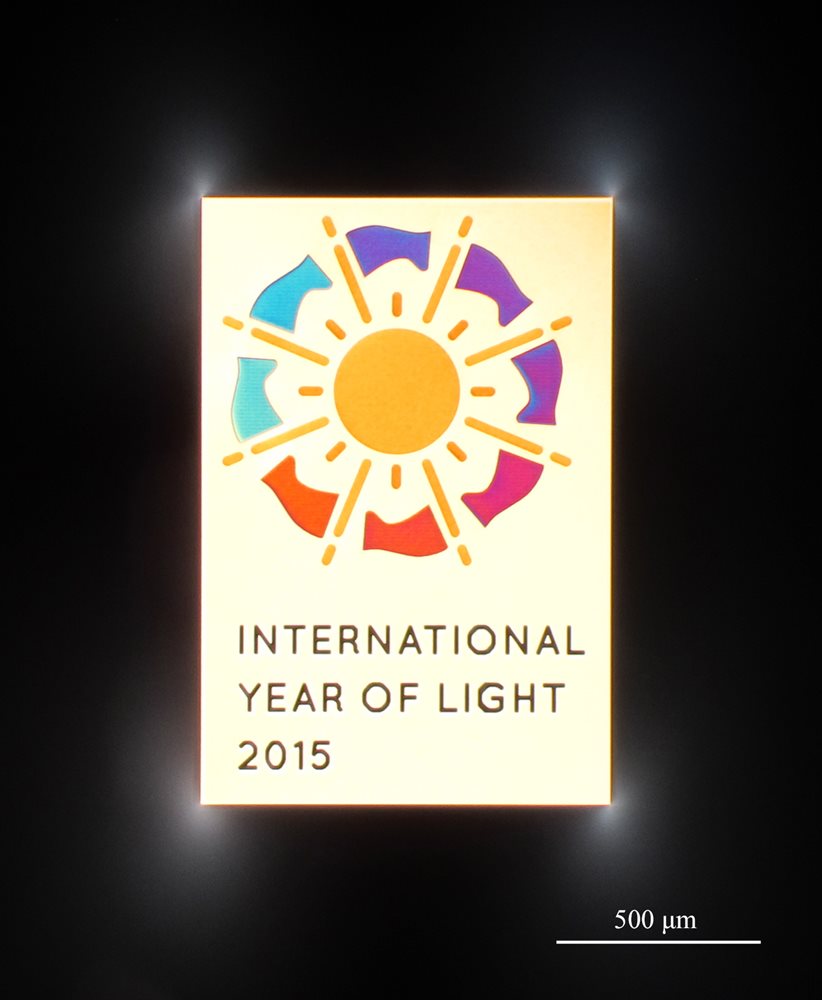
International Year of Light 2015 logo
International Year of Light 2015 logo was fabricated in fused silica glass volume by inducing birefringent nanorgatings using femtosecond laser. Different colors present different retardance induced. Photo taken in cross polarized light.—Titas Gertus, Workshop of Photonics (Altechna R&D)
—
29 Nov 2015

