

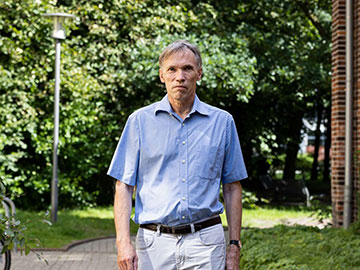
Thomas Luhmann [Image: Jade HS / Andreas Rothaus]
In the latest installment of Journeys in Optics, OPN spoke with Thomas Luhmann, institute board member and professor for photogrammetry, Institute for Applied Photogrammetry and Geoinformatics, Jade University, Germany. Luhmann is a corecipient of the 2026 Joseph W. Goodman Book Writing Award for the textbook, “Close-Range Photogrammetry and 3D Imaging, 4th edition.” Luhmann discussed working in industry, writing and collaborating on a successful textbook and advice for early-career researchers.
How did you first become involved with photogrammetry?
During my early studies in geodesy, I had the chance to work as a student assistant in the institute for photogrammetry, parallel to lectures in photogrammetry.
You and your coauthors received the Joseph W. Goodman Book Writing Award for “Close-Range Photogrammetry and 3D Imaging, 4th edition.” Can you discuss the process of putting this book together?
Soon after I published the first edition of the book in German, colleagues asked for an English translation because there was (and still is) no equivalent book out there. Thus, together with Stephen Kyle, Stuart Robson and Ian Harley, all scientists or professors at University College London, we translated the book, and it was published with Whittles Publishing.
The great success of the book encouraged me to publish the subsequent editions, first in German and then in English. Meanwhile, Jan Boehm joined the team because of his expertise in computer vision. Working on the English version together resulted in updated and improved content, which we then included in the next German version. Each time we worked on an edition, we met in-person in England for two to three intensive days of hard but always very fruitful work, even if we had different technical opinions.
The book won the International Society for Photogrammetry and Remote Sensing Karl Kraus Medal for the best textbook in that field. Being awarded the Joseph W. Goodman Book Writing Award marks another great milestone and acknowledgement of our work in this very fast-developing field. It also will help spread the book even further to different scientific and technical fields, such as medicine, informatics, physics and engineering.
“I wouldn’t have wanted to miss my engagement with Leica, but I was happy to come back to academia and work with students, colleagues and partners. ”
—Thomas Luhmann
How did your time as a project manager and head of R&D Photogrammetry at Leica compare with your academic appointments?
There were many similarities. At Leica, I worked with an absolutely new technological application with new digital cameras, image processing algorithms, photogrammetric methods, mechanical challenges and so on, hence the work was very science- and future-oriented. I also had to manage an interdisciplinary team and a large budget, which helped me to be a successful scientist and institute founder.
However, the pressure of making money and keeping deadlines was much harder than in university, but I learned how to do it. I wouldn’t have wanted to miss my engagement with Leica, but I was happy to come back to academia and work with students, colleagues and partners.
What went into founding the Institute for Applied Photogrammetry and Geoinformatics (IAPG) at Jade University?
At that time, 1993 to 1996, I saw a need for creating my own group where there were shared responsibilities for staff, budget and labs. In addition, up to that point we were strictly organized in faculties that gave no indication of what our specific expertise were to the public. Back then, universities of applied sciences usually did not conduct any research. Soon after my start at Jade University in Oldenburg I changed a lot of old procedures and tasks, intensified research and third-party funding, hired Ph.D. candidates and built the foundation of the later institute. The IAPG was the first institute ever within the university—many others followed after.
Coming from a field with diverse application areas, how do you approach collaboration?
“Collaboration usually starts successfully if you are openminded, creative and flexible—then it becomes a win-win situation.”
—Thomas Luhmann
Photogrammetry is often used in other disciplines, except aerial photogrammetry, which is mainly used to generate geo data, orthophotos and maps. Close-range photogrammetry offers unlimited applications. As a consequence, you often work with people who speak different technical languages and who may have more or less understanding of optics, mathematics, engineering or statistics.
On the one hand, this is a challenge, but it also offers a chance to learn from other fields and to discover very interesting applications. Collaboration usually starts successfully if you are openminded, creative and flexible—then it becomes a win-win situation. For me personally, I have benefitted from a large variety of people with different roots, languages and cultures who have the same objectives and enthusiasm for the technology. This has opened a wide field of possibilities for creating projects, funding and travels.
Is there a particular achievement in your career that you feel most proud of?
My books are surely my biggest achievement, since my name will probably not disappear for a while. It is so great to see how students, scientists and practitioners benefit from my book, creating new solutions, systems or jobs. Secondly, changing the structures of my university is also a long-term achievement. Finally, with respect to my work at university and as a company founder (AXIOS 3D Services in Oldenburg, Germany, and SPM3D in Kyiv, Ukraine, and Valencia, Spain), I’ve helped create a large number of jobs, which still exist today.
What advice do you have for students and early-career researchers?
Giving advice is difficult, since everything depends on the personality of each individual. I can only encourage young people to stay curious, to concentrate on their personal skills and interests, to communicate with others (including older colleagues), to build up and maintain professional networks (in real life, not through LinkedIn), to work according to a certain solid structure, to stand up after failing and to never giving up. If there is a reasonable goal, like finishing a Ph.D., then invest as much as you can when you are young—it will not become easier in later years.
