

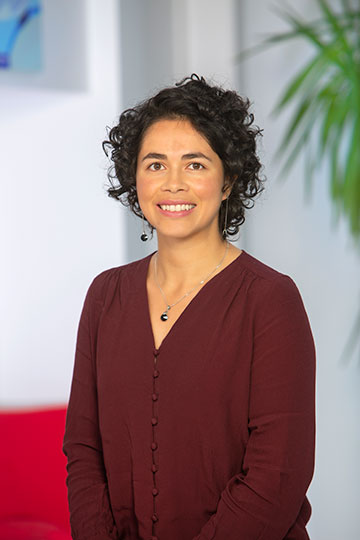
Andrea Pacheco
In the latest installment of Journeys in Optics, OPN spoke with 2025 Optica Ambassador Andrea Pacheco, a Marie Skłodowska-Curie Actions Postdoctoral Fellow at the Lambdalab team at the Politecnico di Milano, Italy. Pacheco discussed her inspiration for becoming a physicist, the importance of outreach, how mentorship and collaboration have shaped her career and becoming a parent as an early-career academic.
How did you become interested in studying physics?
I first decided to study physics in 2005 during a cultural‑exchange year in Germany after finishing secondary school in my native Colombia. One evening, my uncle—who is also a physicist and lives in Heidelberg—invited me to dinner with several of his colleagues. What struck me was not only their passion for science but the diversity of their careers. They all held degrees in the natural sciences, yet they were working in renowned companies, driving innovation in ways I had never imagined. Until that moment, I believed a science degree led almost exclusively to teaching or academia. That dinner completely shifted my perspective. I returned home to Colombia knowing I wanted to study physics, not just to understand the world but to apply that knowledge to create technologies and contribute to scientific progress.
During my bachelor’s studies, I chose “Fundamentals of Optics” under the guidance of Professor Yobani Mejía, who became my mentor and later supervised both my bachelor’s and master’s theses. At first, I imagined myself building telescopes or cameras because astronomy had always fascinated me. But working with Professor Mejía opened an entirely new path: We used a modified Shack–Hartmann test to reconstruct corneal topography. That project sparked my curiosity about biomedical optics and showed me how light could be used not only to observe the universe but to improve human health.
After completing my master’s degree, I joined the Biophotonics@Tyndall group in Cork, Ireland, under the supervision of Professor Stefan Andersson‑Engels. There, I immersed myself in tissue optics and discovered just how many clinical challenges can be addressed with optics and photonics technologies. That experience solidified my commitment to translational research and cemented my desire to move from the lab to real clinical impact.
Later, Professor Paola Saccomandi welcomed me into Lambdalab at Politecnico di Milano, Italy, to write a proposal for a Marie Skłodowska‑Curie Actions (MSCA) fellowship. Her group’s strong expertise in thermometry inspired me to design a project that study thermal and optical changes in tissue during thermal ablation. This allowed me to explore a case where tissue optics could be used to improve the clinical procedures.
Looking back, each step of my journey has reinforced the same realization: Optics and photonics have extraordinary power to transform clinical practice. Over the past two years of my MSCA project, I have had the privilege of deepening my understanding of tissue ablation and its intimate connection to changes in optical properties. And with every new insight, my motivation grows stronger. My path shows that a career in optics and photonics is not linear—it is rather expansive. It can take you from astronomy to ophthalmology, from fundamental physics to life‑changing medical technologies. I love this field because it gives me endless opportunities to make a real impact.
After completing your Ph.D., you took a year off for parental leave. What was it like returning to the lab ?
This is such a tough question! Becoming a mother has been both the most challenging and the most rewarding experience of my life. There is no manual for parenting, and children grow so quickly that just when you think you’ve mastered one stage, like how to help them sleep or encourage them to eat independently, they are already two steps ahead, presenting new and bigger challenges.
Those first months were a whirlwind. I barely had time to shower, the house was a mess and I often wondered, “How am I going to keep up with my career when this tiny human needs 100% of my time and energy?” I doubted my ability to continue growing professionally while being a present mother and partner. Family dynamics change profoundly, and navigating that shift is not easy.
But I am incredibly fortunate to have a supportive and encouraging husband. Marco—if you ever read this, thank you. Thank you for carrying our home on your shoulders during the many weeks I had to travel and for creating a safe and loving space where we can both pursue our careers without sacrificing our family values. Your support kept my doubts at bay.
I was also lucky to have a role model at work. Paola, my PI, became a first‑time mother the very same month I did. She returned to work before me, and when I started my project, she immediately sensed my anxiety. She told me, “You will see, you will be capable of managing both family and career.” Her words and her example have meant the world to me. Having a mentor who understands both the scientific journey and the emotional landscape of motherhood makes all the difference.
Motherhood has reshaped the way I work. I plan my weeks carefully, I build my career development around the reality of having a family, and I prioritize my husband and son above everything else. And surprisingly, I have never been more efficient than I am now. Yes, I end each day tired, but it is a fulfilling kind of tired. I enjoy every minute I spend in the lab, pursuing goals that, fortunately, align with our family’s dreams and values. As parents, we have learned that family life does not diminish our scientific potential (my husband also does research outside academia), it can strengthen it. We can grow as researchers and as parents. And along with building our family, we are also building a future in optics and photonics. We did not have to choose one over the other because we are fortunate to have support, determination and a community that understands we have a life outside the lab.
“Having a mentor who understands both the scientific journey and the emotional landscape of motherhood makes all the difference.”
—Andrea Pacheco
Can you discuss your work in science communication and outreach?
If you met me today, you would never guess how my journey with public speaking began. The first time I had to present a simple 10‑slide talk in my second semester of university, I completely froze. I had a panic attack, ran out of the room with a knot in my throat and burst into tears. My professor followed me out, offered me water and gently asked my classmates to be supportive rather than judgmental. A week later, I returned to the classroom and delivered the presentation with a shaky voice, openly acknowledging that public speaking terrified me.
Everything began to change a few years later when I joined the Universidad Nacional de Colombia, Sede Bogotá (UNBOS) OPTICA and SPIE student chapter. Many of our activities involved outreach in local schools and organizing events at the university. I discovered something important: Speaking in public became much easier when I talked about topics I loved—especially when I could use hands‑on demos that created that “wow” effect.
I also attended a science‑communication workshop that was exactly what I needed at that stage. I practiced relentlessly, and little by little I stopped running away from the challenge. By the end of my master’s, I was still nervous before every talk, but I could stand in front of an audience without losing my voice. Outreach soon became one of my favorite parts of being a scientist. It is incredible how a couple of hours of demos and experiments can reshape a young student’s idea of what their future could look like. I love giving lab tours and explaining my work to anyone who has a few minutes. I even carry a small device with red, green and blue LEDs so I can answer the question “what is biophotonics?” on the spot.
During my Ph.D., an opportunity came up to participate in FameLab—a three-minute science talk competition at Cork—and I decided to join purely to push myself out of my comfort zone. I didn’t expect to reach the final round, but the experience came with exceptional training in science communication. That was when I realized that communication is an art and that you cannot use the same speech for every audience. I was also fortunate to have a supervisor who encouraged us to prepare three versions of every talk: one for peers, one for medical doctors and one for a 12-year-old. After four years of practice, rehearsal and feedback, I finally reached a point where I feel comfortable speaking about my work with anyone.
But the most important lesson I learned is this: Science has no impact if we cannot communicate its relevance and reach. Public speaking is not just a skill, it is a responsibility. And embracing it transformed not only my confidence but also the way I see my role as a scientist.
Can you talk about founding your local Optica student chapter and what professional societies have meant for your career?
Founding my “local Optica Student Chapter” (and I put that in quotes because I did it in a foreign country, just a few months after starting my Ph.D. abroad) was one of the most enriching experiences of my career. At first, I honestly thought it wouldn’t attract many members. European universities already offer incredible resources, and I assumed students might not feel the need for the additional benefits that come with being part of a student chapter. Still, I sent a general email to all students, especially those who already had Optica memberships. To my surprise, after my presentation 12 students immediately volunteered to form the chapter. Later, we also founded the SPIE Student Chapter, and together we organized networking events, outreach activities, workshops and seminars that genuinely benefited the student community.
One of my proudest feelings today is knowing that the chapter is still active—almost eight years after we founded it.
Optica and SPIE have shaped my career in profound ways. They are sister societies and both have opened doors I could never have accessed on my own. Thanks to Optica, I attended my first international conference in Rochester, NY, USA. Three years later, SPIE supported my participation in a conference in Germany. For a Colombian student with limited resources, these opportunities were life changing. Without the support of these societies I simply would not have been able to make it.
Beyond conferences, the collaborative network built through student chapters has been invaluable. Joining forces with the student chapter at University College Dublin, Ireland, to organize an IONS conference; meeting my first mentor through the Mentorloop program; and connecting with peers around the world—these experiences have shaped not only my professional path but also my sense of belonging in the global optics and photonics community.
Founding a chapter abroad taught me that leadership is not about having all the answers, it is about creating spaces where others can grow, collaborate and dream bigger. And seeing those chapters thrive long after my Ph.D. reminds me that the impact of student leadership extends far beyond our own time in the lab.
What impact has interdisciplinary collaboration had on your work?
My Ph.D. took place within a deeply interdisciplinary project, where I worked side by side with medical doctors, scientists and engineers from backgrounds very different from my own. My research group itself was a blend of disciplines, and I quickly saw how powerful this approach could be. Problems that seemed complex or slow to solve suddenly became manageable when viewed through multiple lenses. Many of the solutions I developed during my Ph.D. were born not in formal meetings, but in spontaneous “coffee‑talk ” conversations with students from completely unrelated fields.
Experiencing this culture for more than four years shaped the way I think and approach scientific challenges. It taught me that interdisciplinarity is a mindset. It keeps your mind open to possibilities you would never consider on your own.
So, when I had the opportunity to write my MSCA proposal, I made it clear that collaboration across disciplines was essential. Finding a veterinarian willing to support my ideas was not easy, but eventually I found the right partner, and our discussions have been incredibly enriching. Working with someone who sees biological systems from a completely different perspective has expanded my understanding and strengthened the project in ways I could not have achieved alone.
Today, I am part of Lambdalab in the Department of Mechanical Engineering at the Polytechnic of Milan, and this environment continues to broaden my perspective. Approaching biomedical challenges from an engineering mindset brings new tools, new questions and new ways of thinking. It reinforces what my Ph.D. taught me: Innovation thrives when diverse minds come together.
Interdisciplinarity, to me, is the art of keeping the mind open to new methods, collaborators and solutions. It is one of the most powerful drivers of progress in science.
Can you tell us about being an Optica Ambassador?
Becoming an Optica Ambassador was truly a dream come true. I still remember attending the Student Leadership Conference in Washington, DC, USA, in 2019. The ambassadors that year organized great workshops, and their stories were so powerful that I left feeling deeply inspired. I remember thinking, “I hope that one day I can be as impactful as they are.”
Now that I am an Ambassador myself, my favorite part is the sense of community that comes with it. It feels like being part of a family—a global network of highly skilled, motivated professionals who genuinely care about expanding the reach and benefits of Optica. What makes it beautiful is that we all share the same mission: to support students and early-career researchers so they can become the best version of themselves. This year, our ambassador community grew to 110 members, and I admire each one of them.
“Founding a chapter abroad taught me that leadership is not about having all the answers, it is about creating spaces where others can grow, collaborate and dream bigger.”
—Andrea Pacheco
As a Colombian, I feel a special responsibility to give back to the organization that has given me so much. I am committed to supporting student chapters across Latin America—and really, anywhere in the world—by helping students make the most of their chapters and their individual memberships. One of my most memorable experiences was being invited as a speaker for a three‑day event organized by the Student Chapter at Universidad Autónoma de México. They kept me wonderfully busy with a different talk each day, and I was incredibly impressed by the quality of their research projects and laboratories. At the event, I also met students from the metropolitan region who became motivated to start chapters at their own universities. And one student in particular told me she didn’t believe she could win a scholarship, yet after our conversation, she applied and she got it. When she shared the news, I felt as if I had received the scholarship. Moments like that remind me why I love serving students.
Being a mentor has also been a deeply constructive experience. Every mentee represents a different journey, and I enjoy seeing how we help each other grow professionally. Supporting students, sharing opportunities and watching their confidence grow is one of the most fulfilling parts of being an Optica Ambassador.
Is there anything you wish you had known earlier in your career that you would like to share with students and early-career researchers?
I wish I had understood much earlier the value of having a mentor. During my bachelor’s and master’s studies in Colombia, I often faced difficult moments alone, simply because I didn’t know that seeking mentorship was not only acceptable but transformative. Having someone who has walked a similar path, who has struggled, learned and thrived through the same challenges you are facing, is a gift.
I met my first mentor during my Ph.D., and she became a cornerstone in my journey. She guided me through everything: writing and submitting my thesis, publishing papers, preparing my MSCA proposal, moving to Italy, starting a family and even getting married… all in the middle of a global pandemic! Her support didn’t just help me succeed academically; it helped me grow as a person.
If I could speak to my younger self, I would also say this: Learn to work smarter, not harder. And don’t confuse the two. Working smarter means protecting your mental and physical health because an exhausted mind inside a tired body cannot solve the complex problems we face in science. Rest is not a luxury; it is part of the process.
Working smarter also means surrounding yourself with inspiring, outstanding peers. Nowadays, it is impossible to advance alone. Science moves forward when we collaborate, when we share ideas and when we lift each other up. A team mentality is essential—we do not have to navigate our journeys alone. We can seek mentors and build community because progress in science is not just about individual brilliance, it is about collective effort, shared curiosity and the courage to ask for guidance when is needed.
