

Light Touch
From Newton to Eddington
A 1919 expedition leveraged an eclipse to validate Einstein’s theory of general relativity, but that wasn’t the end of the controversy.
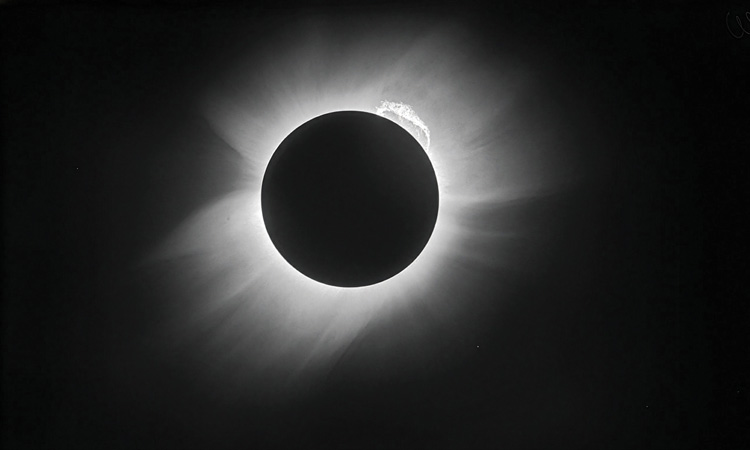 An image of the May 1919 solar eclipse taken during the Eddington experiment. [ESO / Landessternwarte Heidelberg-Königstuhl / F.W. Dyson, A.S. Eddington and C. Davidson]
On 29 May 1919, Arthur Stanley Eddington and Frank Watson Dyson made observations of the positions of stars around the sun during a total solar eclipse. Their aim was to measure the gravitational deflection of starlight as a test of Albert Einstein’s theory of general relativity. Their measurements showed the amount of deflection predicted by Einstein’s theory, and the Eddington experiment was declared to be proof of general relativity by a joint meeting of the Royal Society and the Royal Astronomical Society in London. Although this was an esoteric and complex result, it made headlines around the world—and Einstein was vindicated. Of course, it wasn’t that simple.
…Log in or become a member to view the full text of this article.
This article may be available for purchase via the search at Optica Publishing Group.
Optica Members get the full text of Optics & Photonics News, plus a variety of other member benefits.
