

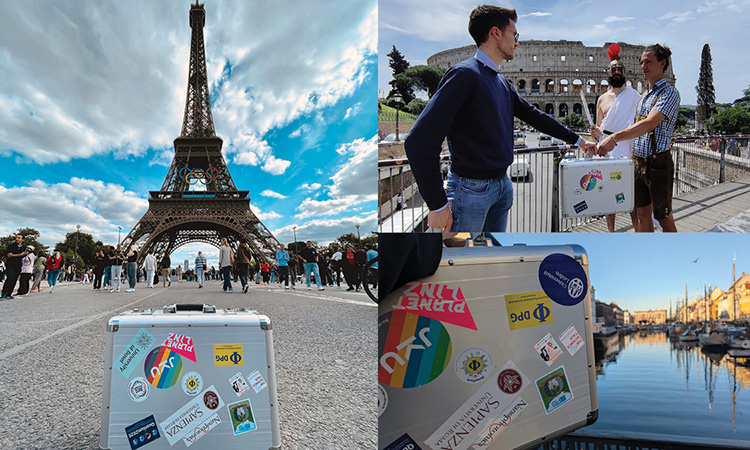
 A quantum light source in a suitcase visited 12 labs in 12 countries, each stop commemorated by a sticker. [Courtesy of QuanTour]
As the quantum science world prepared for the UNESCO International Year of Quantum Science and Technology (IYQ), two researchers came up with a unique idea to unite research groups and spread the word about quantum—some of IYQ’s key goals. Doris Reiter, Technische Universität Dortmund, Germany, and Tobias Heindel, Universität Münster, Germany, thought, what if we had a quantum emitter journey around Europe, like an Olympic torch ushering in IYQ?
Years of planning and preparation preceded IYQ, and the German Physical Society created a task force to develop plans for the celebration in 2020. The traveling quantum emitter, dubbed QuanTour, was born of these planning meetings as Reiter and Heindel brainstormed new modes of outreach. “It’s giving a voice to our field and to young people by doing something fresh and new,” Reiter said. “It’s not another conference or another book—we wanted to do something different.”
An emitter hits the road
QuanTour set out on 14 April 2024, World Quantum Day, and completed its journey one year later on World Quantum Day 2025. The expedition kicked off in Linz, Austria, and brought a quantum light source housed in a sleek silver suitcase to 12 labs in 12 countries across Europe.
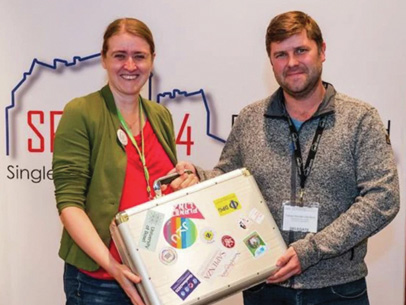 Doris Reiter (left) and Tobias Heindel holding the quantum light source. [Chris Watt Photography]
To celebrate and document the journey, scientists at each lab filmed themselves receiving the emitter and then sending it off by ceremoniously placing a sticker on its suitcase. Heindel and Reiter said seeing the creative and silly side of researchers on display in these videos was one of their favorite parts of the program—for instance, a skit from the group in Rome in which a scientist dressed in a gladiator costume received the suitcase and then opened the door to the university with a “quantum key.” “I really loved watching them. It was a true highlight how they embraced their culture, the quantum culture, and made it into something so fun,” Reiter said.
Validating the light source
At the heart of QuanTour is the quantum light source—a single semiconductor quantum dot integrated into a dartboard-shaped microcavity to enhance the device’s photon-extraction efficiency. The cutting-edge technology allows the single emitter to produce single photons repeatedly on demand, an innovation that could play an important role in the future quantum internet and have real-world applications for inter-city quantum key distribution.
QuanTour has a far-reaching social media presence with more than one million views across platforms.
During the tour, researchers at each lab were asked to perform correlation measurements to validate the emitter’s ability to generate single photons. Since the source was a novel device completed just in time for its quest by Heindel’s graduate student Lucas Rickert, these measurements were more than an educational exercise for the researchers. Reiter and Heindel explained that they expected to get similar results from each lab, but when the graphs were compared, they looked different. It turned out that the quality of the photons produced was affected not only by the emitter but also by the excitation conditions. Reiter says this unexpected result raises an important question: How do we actually rate the quality of a quantum emitter?
The groups also had the opportunity to run their own experiments. The lab in Rome wanted to measure the Zeeman splitting between different excitonic species by applying a strong magnetic field, while others tinkered with types of optical excitation and experimental configurations.
Outreach beyond the lab
The device’s journey was also intriguing to many outside the quantum-research world. Heindel and Reiter partnered with science communicator Pranoti Kshirsagar to develop a communications strategy and encourage research spaces to expand their outreach to the general public. As a result, QuanTour recently won the Lise Meitner Medal from the Institute of Physics for its outstanding contributions to the public understanding of physics.
Many hosting labs opened their doors for open nights, welcoming community members interested in learning about their research and quantum more broadly. Some labs went the extra mile—in Poland, the lab organized a two-day event complete with laser games, lab tours and demos of the quantum light source. In Turkey, QuanTour joined forces with an event called IZTECH Quantum Days, and at least 300 students filled a lecture hall to hear a two-day quantum lecture series.
QuanTour also has a far-reaching social media presence with more than one million views across platforms. Students and researchers recorded videos of the experiments performed with the emitter, which were then curated for the QuanTour social media accounts to give viewers a taste of working in quantum research.
To provide a deeper dive into a labs’ work, Reiter and Heindel worked with Kshirsagar to develop episodes for her podcast The Science Talk. Episodes include interviews with hosting researchers and in-depth conversations about the science, with a focus on making these complex topics more accessible.
Although IYQ is coming to an end, QuanTour is far from over as it sets out on a world tour this autumn. In September the source was in Canada, with Singapore, China and Australia slated for future visits, highlighting the program’s ability to transcend cultures and promote a collaborative spirit. “Science bridges cultures,” says Reiter. “It helps us communicate and brings us all together.”
Rachel Sender is OPN’s associate editor.
