

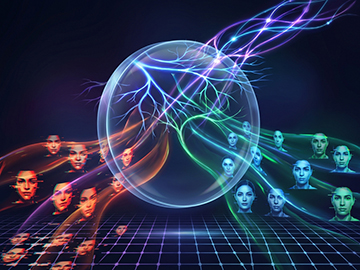
A hybrid digital-optical system can identify deepfake videos on multiple channels at the same time [Image: Ozcan Lab / UCLA]
Researchers at the University of California, Los Angeles (UCLA), USA, have developed a scalable digital-optical processor that accurately detects deepfake videos when analyzing 15 or more video channels at the same time (eLight, doi: 10.1186/s43593-026-00143-y). Combining digital neural networks with an optical engine that supports high-speed parallel processing, the hybrid system offers a robust and efficient solution for content providers to identify AI-generated visual media.
The need for deepfake detection
The rapid proliferation of realistic AI-generated content has created an urgent need for reliable and robust deepfake detection. Deep-learning models have been shown to accurately identify manipulated media, but the scalability of digital processing is limited by the high computational overhead and the need to process videos sequentially. Current deepfake detectors are also susceptible to adversarial attacks, with even small changes to the input videos rendering pre-trained models unable to distinguish synthetic media from authentic content.
In the hybrid architecture designed by Aydogan Ozcan and colleagues, digital neural networks are first used to extract spatial, temporal and spectral information from a random selection of frames taken from each video. These data are then encoded into a phase pattern that can be displayed on a spatial light modulator, generating a single optical field containing the information from multiple video streams. After the field has propagated through free space the intensity distribution is captured by an array of paired detectors, with the intensity difference between each pair indicating whether a particular video is real or fake.
Leveraging a hybrid framework
The UCLA researchers tested their hybrid framework using 15 celebrity videos taken from Celeb-DF, a benchmark dataset that includes face-swap manipulations alongside the original content. The system was able to distinguish between real and fake videos with an accuracy of 97.8%, while its near-perfect sensitivity across all channels almost eliminates the possibility of missing a manipulated video. When the multiplexing capacity was increased to 18 videos per optical pass, the system maintained an average accuracy of 96.1%.
The team also showed that adding diffractive optical elements into the optical path can further improve the performance of the processor. When using a dataset containing more challenging deepfake manipulations, the detection accuracy increased from 89.0% for the original system to 95.8% with the addition of two diffractive layers. With this enhancement, the hybrid architecture outperformed the best digital deepfake detector while using around 10 times less energy.
Further tests showed that the system can adapt to video content created using the latest tools for generative AI, such as Google's Gemini platform, which lack many of the artifacts found in earlier deepfakes. The optical processor was also able to handle real-world imperfections in video quality, while its physical nature makes it inherently resilient to adversarial attacks.
Ozcan and colleagues say that the hybrid processor offers the speed and reliability needed to provide a first-pass screening system for online content providers. "More broadly, this work highlights the potential of hybrid optical-electronic computing as a scalable and physically secure paradigm for trustworthy AI systems," they conclude.
