

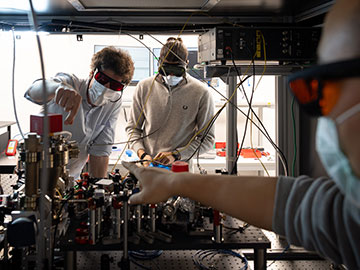
The researchers of the ArQuS Lab. [Image: University of Trieste]
Researchers based in Italy and Germany have developed a novel approach for detecting individual atoms in a rapid and minimally destructive way by leveraging an imaging scheme based on fluorescence microscopy (Phys. Rev. Lett., doi: 10.1103/n3bg-7yw7).
While current techniques typically rely on collecting fluorescence under continuous laser cooling, the new method operates in a nonequilibrium, cooling-free regime where atoms scatter a burst of photons in a short time. The results demonstrate the fastest neutral-atom imaging to date that combines high fidelity and high survival for applications in quantum simulation, metrology and computing platforms.
Like a camera flash
Arrays of individually trapped neutral atoms are one of the most promising platforms for the development of quantum technologies, such as quantum computing and next-generation atomic clocks. However, a key challenge when working with individual atoms is being able to detect them in a precise and nondestructive way. Most single-atom imaging schemes that fulfill these requirements have long imaging durations, from ten to hundreds of milliseconds, which limit the experimental repetition rate.
“Long exposures and fine-tuning of the atom trapping-light parameters are essential for laser cooling to be effective during the imaging process, counterbalancing photon recoil heating and thus preventing atom loss,” said Francesco Scazza, University of Trieste, Italy. “As a side effect, slow detection makes it impossible to identify whether more than one atom is present in a single trap.”
During such short illuminations, atoms gain energy upon scattering photons but not enough to escape the optical tweezer traps in which they are held.
To this end, Scazza and his colleagues adopted a different strategy, analogous to using a camera flash. They illuminated the atoms with a train of very short, counter-propagating intense laser pulses to excite strong fluorescent emission. During such short illuminations, atoms gain energy upon scattering photons but not enough to escape the optical tweezer traps in which they are held. Fast cooling pulses then remove the excess energy introduced by the imaging process.
State-of-the-art performance
The researchers achieved microscale-detection of single ytterbium atoms trapped in optical tweezer arrays with fidelities exceeding 99.9% and less than 0.5% losses. The results—gathered on a time scale that is roughly 1,000 times faster than typical acquisition times—match state-of-the-art performances in alkaline-earthlike atoms in terms of high fidelities and survival. The technique can also detect multiple atoms within a single trap.
“Nondestructive fast detection is an important step toward the implementation of error correction in quantum computers,” said Scazza. “In a similar perspective, the demonstrated fast measurement and atom re-use capability will be instrumental to the minimization of dead times in new-generation atomic clocks, where strong ongoing endeavors are dedicated to the realization of so-called continuous clock architectures.”
