

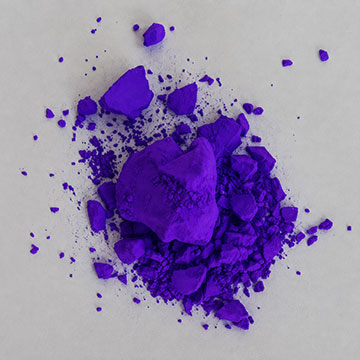
The electrospun purple fabric developed for passive radiative cooling and personal thermal management. [Image: Adelaide University]
Researchers in China and Australia have created a purple fabric that incorporates a metal-organic framework (MOF) to keep people cooler in hot weather (Small, doi: 10.1002/smll.74745). While passive radiative cooling fabrics are typically an intensely bright white, the novel fabric uses the MOF purple ZIF-67 to achieve a pronounced cooling effect compared with commercial cotton fabrics in outdoor tests.
“We have traditionally had to make a choice between cooling performance and appearance,” said study author Jun Ma, Adelaide University, Australia. “Our research shows that we can have both. We can make a fabric that looks purple, but at the same time reflects most of the sun’s energy and releases heat very efficiently.”
Radiative cooling goes purple
Clothing with passive radiative cooling technology has the potential to mitigate the most dangerous effects of intensifying heatwaves, such as heat exhaustion and heat stroke. However, up to this point such fabrics have been limited to white colors that maximize solar reflectance and minimize heat absorption, rather than focusing on body heat emitted as mid-infrared radiation. Nevertheless, dark colors like purple remain challenging, given their strong absorption of green light during the peak region of solar irradiance.
“For outdoor workers, athletes and anyone exposed to hot weather, staying cool is not just about comfort,” said study author Yangzhe Hou, Adelaide University, in a press release associated with the research. “We are interested in developing fabrics that can help manage body temperature without consuming additional energy.”
Ma, Hou and their colleagues started with purple ZIF-67, a MOF with optical absorption confined to the visible region (500-600 nm) and high reflectivity in the near-infrared, as well as high mid-infrared emissivity for radiative cooling. They employed a one-step electrospinning strategy to fabricate spectrally selective nanofibrous fabrics consisting of a thermoplastic polyurethane fibrous matrix with incorporated ZIF-67 and zinc oxide nanoparticles.
Cooler temperatures, superior comfort
The resulting fabric achieves a high mid-infrared emissivity of 96.4% due to the ZIF-67 and an average solar reflectance of 87.6% due to the synergistic scattering with zinc oxide nanoparticles. Outdoor tests with an experimental apparatus under direct sunlight show that the fabric remains 4.2 °C and 6.2 °C cooler than commercial white and purple cottons, respectively.
Practical field assessments under typical working conditions demonstrate superior wearing comfort for outdoor workers in hot weather, thanks to effective moisture management, mechanical flexibility and UV protection. The work could ultimately pave the way for cooling clothing in a much wider range of colors, according to the researchers, by using MOFs with different optical properties.
“The long-term opportunity is to move beyond the idea that cooling fabrics have to be white,” said Hou. “However, there is enormous potential to combine color, comfort and cooling performance in the next generation of textiles.”
