

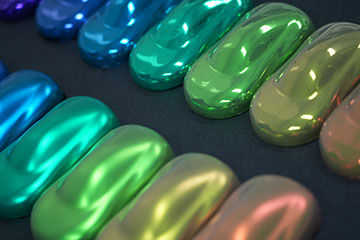
A nanostructured coating creates vivid structural color that can be applied to complex surfaces. [Image: Kobe University]
Researchers at Kobe University in Japan have created a nanostructured coating that creates vivid, glossy colors on complex 3D surfaces (Small Struct., doi: 10.1002/sstr.70600). Designed for real-world use, the coating provides a uniform and long-lasting color that is unaffected by the protective layers typically used for cars, planes and architectural structures.
Toward longer-lasting color
Normal paints and colored coatings exploit relatively large pigment particles, generating diffuse reflection that limits the shine and color saturation of the surface. Metallic paints containing smaller organic pigments offer a more lustrous alternative, but extended exposure to ultraviolet light can cause these pigments to degrade and alter the coating’s visual appearance.
“Color coatings are expected to provide vivid color, brightness, gloss and long-term durability, yet no existing technology satisfies all of these requirements simultaneously,” says project co-lead Hiroshi Sugimoto.
Sugimoto and his colleagues believe that the solution lies in structural color, which exploits the way that nanostructured materials interact with light. However, most of these materials are strongly iridescent, changing their hue when viewed from different angles, and their precise fabrication methods makes them difficult to apply to large and complex surfaces.
A silicon solution
The team at Kobe University has previously shown that these problems can be overcome by making the nanospheres from silicon. Rather than relying on a periodic structure, the individual silicon particles induce strong interactions with light that yield a single, stable structural color. Only a single layer of nanospheres is needed to create a brightly colored surface, which could dramatically reduce the weight of the coating on larger structures.
One remaining drawback is that the nanospheres are arranged randomly within the layer, which produces diffuse reflectance and a matte appearance. But the researchers found that encasing the nanospheres inside a silica shell, a solution originally conceived to protect the nanospheres for ink-jet printing, could overcome the problem. Their analysis suggests that the silica shells act like natural spacers that control the interactions between neighboring nanospheres while also helping the particles to align themselves into an ordered array.
Vivid structural-color coatings
Numerical simulations suggest that a self-assembled monolayer of the silica-encased nanospheres could achieve a peak reflectance exceeding 90%, compared with around 60% for bare silicon. While monolayers produced in the lab did not form a perfectly ordered layer, they still yielded a total reflectance of more than 75% with a strong specular component.
Applying the coating to model cars produced brilliant, metallic-like structural colors ranging from purple to red. A smooth surface yielded a shiny finish, while a rougher one created a matte appearance with a slight sheen. Tests also showed that the vibrant color and surface finish were preserved when a clear topcoat was added.
With industrial applications in mind, Sugimoto says that the nanoparticle layers could be applied using large-scale coating methods such as spray painting and roll-to-roll processing. “Looking ahead, we aim to develop multifunctional silicon nanoparticle coatings that combine structural coloration with additional optical functions such as sensing, photocatalysis and energy management.”
